Read the Wrinkle · Nº 2
Why a waistband gapes at the back
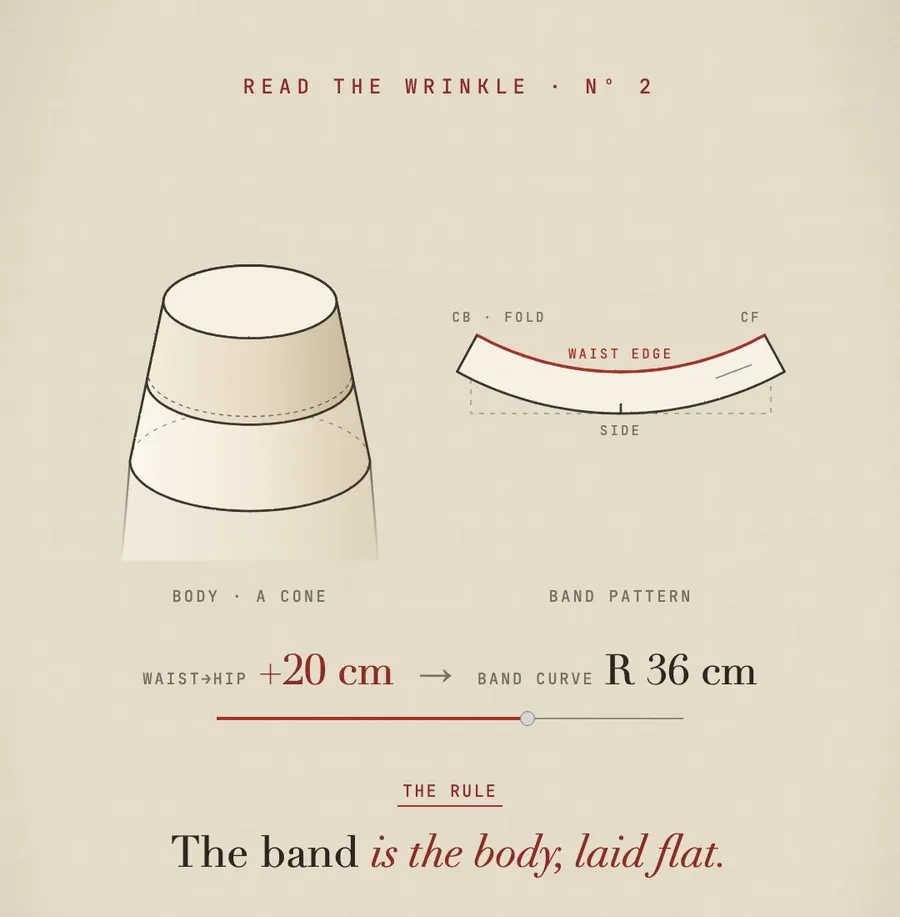
A waistband gapes because a straight band is cut for a tube, but between the waist and the high hip the body is a cone. Cut the band as a curved slice of that cone, a contour waistband, and both edges follow the body.
DrapeXD · Updated
The body is a cone here
From the waist down to the high hip, the body gets wider. Seen as a shape, that stretch of body is a cone, not a tube.
A straight band is cut for a tube
A straight waistband has two edges of the same length. On a cone, the band fits at one edge and the other edge has too much length, so the top edge stands away from the body. That is the gape you see at the back.
Cut the band as a slice of the cone
Unroll a slice of a cone and you get a curved strip: both edges curve, and the waist edge is shorter than the lower edge. Cut the band that shape and it lies flat on the body.
The bigger the difference between waist and hip, the tighter the curve. A contoured waistband isn’t decoration; it is the body, laid flat.
Watch the reel
Try it in DrapeXD
- Measure round the form at the waist and a little lower with the tape.
- Draw the band as a curved strip whose waist edge matches the shorter measurement.
- Sew it to the trousers or skirt and drape: check the top edge at the back.