The Hidden Rule · Nº 4
Darts turn flat cloth into 3D
A dart is a wedge of cloth taken out and sewn closed. Closing the wedge forces the flat cloth to rise into a cone, so a bigger dart makes a deeper shape and a smaller dart a flatter one.
DrapeXD · Updated
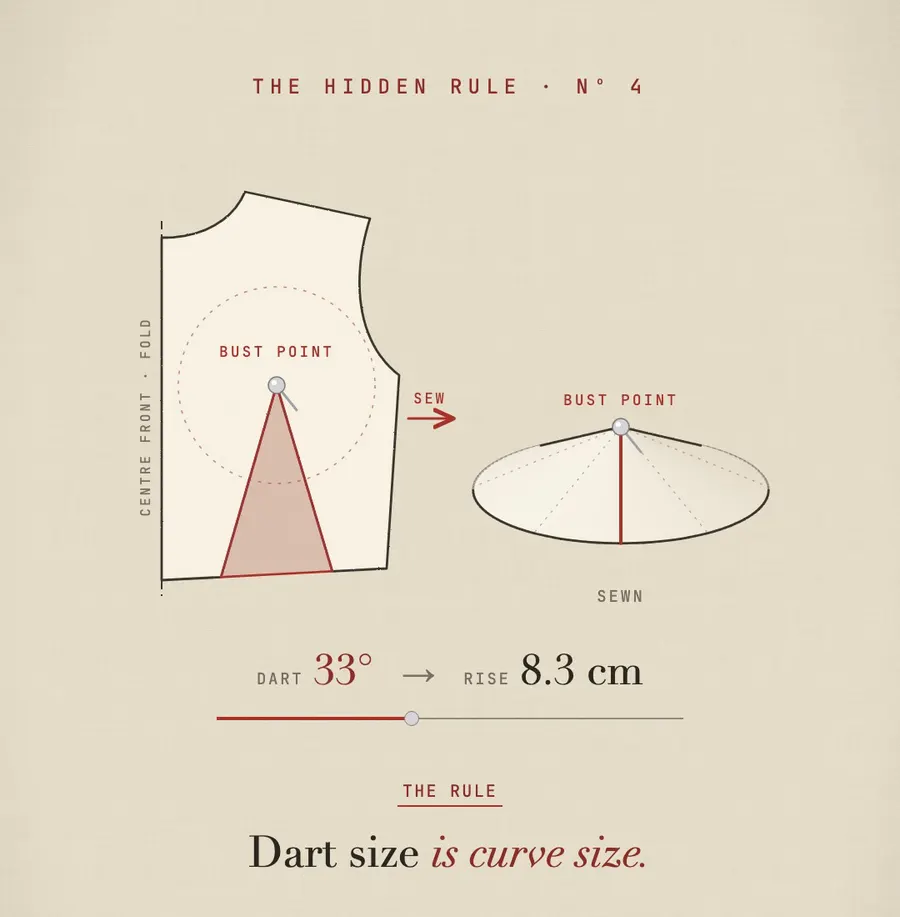
The circle and the wedge
Take a flat circle of fabric and cut a wedge out of it, from the edge to the centre. Bring the two cut edges together. The circle can’t stay flat any more: it rises into a cone, with its point where the wedge pointed.
Dart size is curve size
Make the wedge wider and the cone gets taller: more shape. Make it narrower and the cone flattens: less shape. That is all a dart does, and it is why dart size is the first thing to look at when a garment is too full or too tight over a curve of the body.
A bust dart is exactly this
On a bodice, the bust dart is a wedge whose point sits at the bust point. Sewn, it builds a cone over the bust. Moving the dart to another seam, or splitting it into two, keeps the same cone; only where the wedge is taken out changes.
Watch the reel
Try it in DrapeXD
- Put a dart in a bodice piece and press Play to see the shape it makes on the form.
- Make the dart wider or narrower and drape again: watch the shape over the bust grow or flatten.
- Colour the cloth with the fit map to see where it is stretched or loose.
Step-by-step guides: Dart · Fish-eye dart · Drape · Fit map