Read the Wrinkle · Nº 1
Why trousers pull at the crotch, and the fix
Trousers pull into the crotch when the crotch seam is too short. Strain lines point towards the area that is short of fabric. Check the crotch length, and if the pattern is short, extend the back crotch point and lower the back curve slightly.
DrapeXD · Updated
Read the wrinkles
Strain lines point toward the area that is short of fabric. Fine lines radiating from the crotch mean the crotch length is too short.
The crotch is a curve, not a width
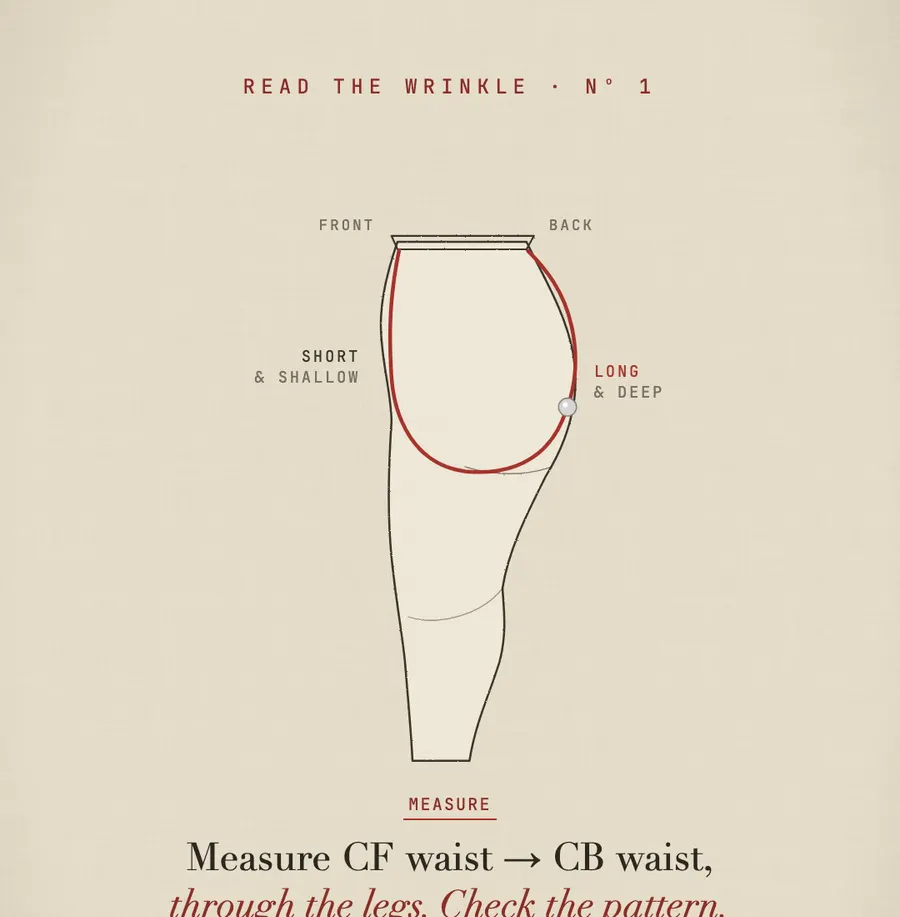
Many patterns treat the crotch as a width. It is a curve, and on most women it is a J, not a U: the front is short and shallow, and the back is longer and deeper, to clear the seat.
If the back curve is too shallow, the seam is pulled up into the body.
Check it, then fix it
Measure the crotch length on the body: from the centre front waist, between the legs, to the centre back waist. Compare it with the pattern’s crotch seam.
- If the pattern is short, extend the back crotch point and lower the back curve slightly.
- Remember the rule: wrinkles point to what’s missing.
Watch the reel
Try it in DrapeXD
- Start a pair of trousers from a block, for women or men.
- Drape them and colour the cloth with the fit map to find the strain.
- Measure the crotch seam on the pattern and compare it with the form.