Ever Noticed? · Nº 1
Why curved seams get clipped
On a curved seam, the seam allowance’s cut edge is a different length from the stitch line. Clipping lets the allowance of an inward curve spread open; notching takes the extra out of an outward curve. Either way, the turned seam lies flat.
DrapeXD · Updated
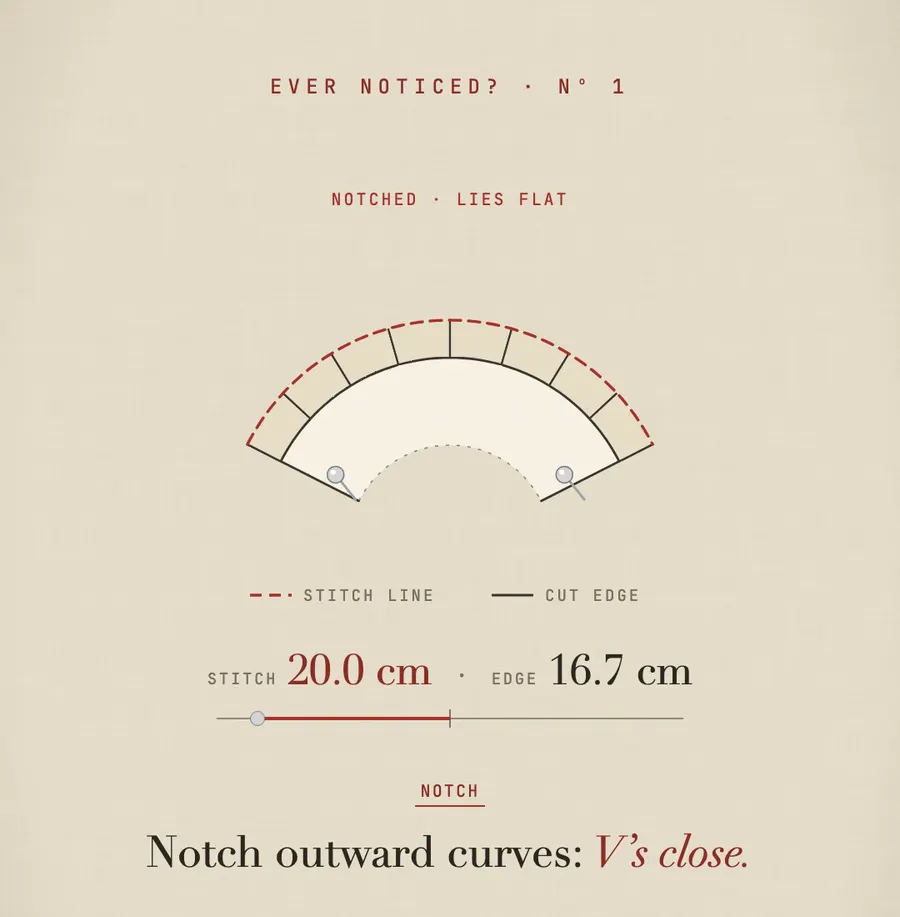
Two lines, two lengths
On a straight seam, the stitch line and the cut edge of the allowance are the same length. On a curve they never are, because the cut edge runs on a bigger or smaller circle than the stitching.
Outward curves: too much edge
On an outward curve the cut edge is longer than the stitch line. Turn the seam in and that extra length bunches up. Notch it: cut small wedges out, and when the seam is turned the wedges close up.
Inward curves: too little edge
On an inward curve the cut edge is shorter. Turn it and it pulls tight. Clip it: straight cuts towards the stitching, so the allowance can spread open.
The tighter the curve, the more cuts it needs.
Watch the reel
Try it in DrapeXD
- Measure a curved edge of a piece, then measure along its stitch line, and compare the two lengths.
- Choose how the seam is sewn and finished, then drape it.