How 3D fashion works
How 3D garment simulation works: from one particle to a dress
A 3D garment is made of thousands of tiny points of cloth. Each flat pattern piece is filled with them, seams join the pieces point to point, and the simulation pulls the seams shut and lets the cloth settle on the body, stretching and bending like fabric.
DrapeXD · Updated
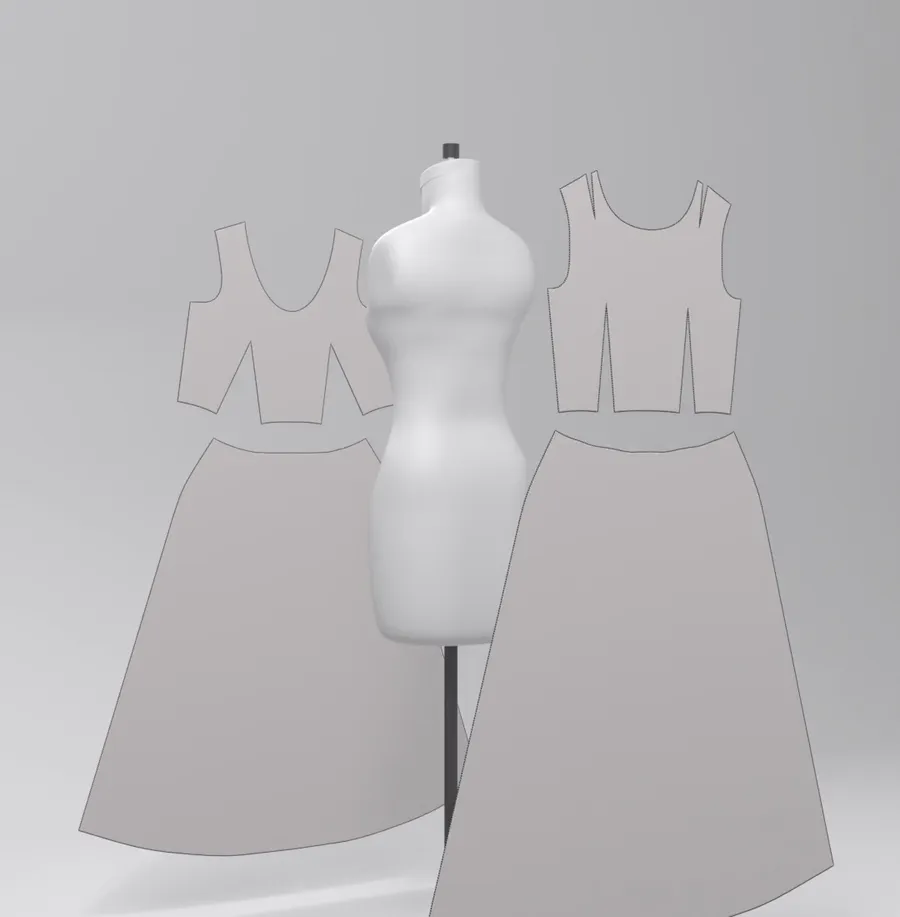
A pattern piece becomes a net of points
Cloth simulation does not see a pattern piece as a shape. It fills the piece with small, nearly equal triangles, and every corner of every triangle is a point that can move: a particle of cloth.
Thousands of particles make one pattern piece. Each triangle edge acts like a short thread between two particles, so the net stretches and bends the way the fabric would.
Seams join pieces point to point
A seam is a list of point pairs: each point on one edge is paired with a point on the other. In DrapeXD, notches that are paired across a seam land on the same stitch, so the pieces line up where you marked them.
When the drape starts, the seams pull shut and then weld, and the separate flat pieces become one garment.
The drape settles on the body
Each step, the simulation moves every particle under gravity, then corrects the positions so threads keep their length, folds resist bending the way the fabric does, and no particle passes into the dress form. Repeat that many times a second and the garment settles into its drape.
DrapeXD’s own simulation uses a published method called XPBD (extended position-based dynamics), run on the computer’s processor, which is why it needs no graphics card for the drape.
Watch the reel
Try it in DrapeXD
- Sew two pieces together and press Play to watch the seams pull shut and the cloth settle.
- Colour the cloth with the fit map to see where it is stretched.
Step-by-step guides: Sew · Arrange & drape · Drape · Fit map